

Shifting from Fixing to Facilitating and Leading Without Burnout
In corporate organizations across industries, high-performing women frequently face a common structural challenge: the transition from outstanding individual contributor to executive leader. In a featured conversation on the UPSURGE! podcast with host Evelyn, Laurie Maddalena—leadership provocateur, speaker, founder of Envision Excellence, and author of The Elevated Leader—dissects what she terms the “working manager trap.” This exhausting cycle occurs when talented professionals are promoted into management based on technical excellence, yet remain trapped in hands-on execution, firefighting, and constant busyness.
Transforming this operational bottleneck into sustainable executive authority requires far more than working longer hours or managing tighter schedules. As Maddalena establishes, modern leadership demands an intentional shift in identity, organizational support systems, and energy management that enables leaders to empower their teams while protecting their personal well-being.
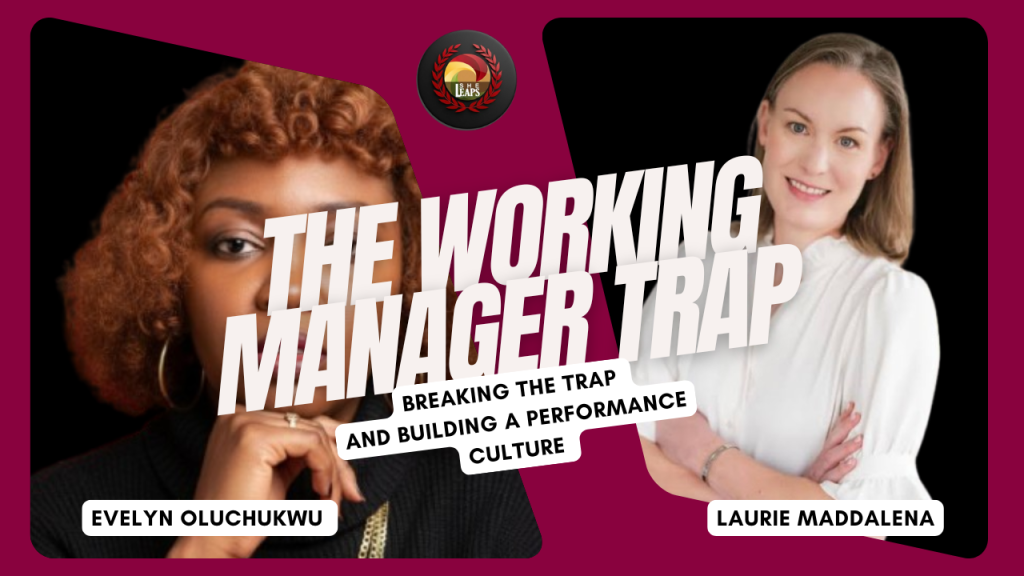
- The High-Performer Paradox: Escaping the Execution Trap
The journey to executive leadership often begins with a paradox. The very traits that earn professionals early recognition—technical mastery, personal problem-solving, and direct execution—can become the exact obstacles that prevent them from scaling their impact as managers.
When high performers enter managerial roles without explicit frameworks for transition, they frequently default to what made them successful as individual contributors. They remain deeply immersed in daily tasks, step in to solve operational problems themselves, and maintain constant busyness as a proxy for productivity.
The Cycle of Managerial Execution
Technical Excellence \rightarrow Promotion to Management \rightarrow Defaulting to Hands-on Execution \rightarrow Constant Busyness \rightarrow Team Friction & Dependency \rightarrow Operational Burnout.
This cycle creates significant organizational friction:
- Micro-Management and Bottlenecks: When leaders continuously execute operational tasks, decision-making slows down, creating dependencies where team members wait for managerial approval or intervention.
- Stunted Team Growth: By solving problems directly rather than guiding team members to find solutions, leaders unintentionally deprive their staff of professional development opportunities.
- Executive Exhaustion: Attempting to maintain individual execution responsibilities alongside strategic management duties inevitably leads to cognitive overload, stress, and burnout.
- From Fixer to Facilitator: Reimagining Leadership Identity
Overcoming the working manager trap requires shifting from a “fixing” mindset to a “facilitating” posture. Relying primarily on technical expertise limits a leader’s organizational reach. True leadership capability lies in facilitating growth, cultivating autonomy, and elevating team performance.
Navigating the Personal Identity Shift
For many leaders, letting go of hands-on execution triggers a subtle identity crisis. High performers are accustomed to deriving their professional self-worth and visible value from tangible deliverables—completing projects, answering technical questions, or closing deals. Moving into facilitation requires redefining what constitutes value.
Leadership Dimension Traditional “Fixer” Leadership Modern “Facilitator” Leadership
Primary Focus Direct execution and technical problem-solving Strategic direction, team empowerment, and system design
Response to Issues Giving directions and supplying immediate answers Asking guiding questions and encouraging autonomous problem-solving
Source of Value Personal technical expertise and task completion Collective team capability, growth, and organizational impact
Workplace Dynamic High dependency on managerial intervention High autonomy, accountability, and distributed initiative
The Power of Question-Based Leadership
Facilitation centers on replacing directive instruction with inquisitive coaching. When team members bring challenges to a leader, an effective facilitator refrains from immediately supplying the solution. Instead, asking targeted, reflective questions empowers team members to analyze scenarios, evaluate options, and take ownership of decisions. This approach builds problem-solving capacity across the department and establishes a culture of continuous learning.
- Overcoming Systemic Promotion Flaws in Modern Organizations
The prevalence of the working manager trap points to a broader systemic flaw in corporate talent management. Organizations routinely identify top-performing individual contributors and promote them into management positions without providing structured leadership training, onboarding, or ongoing support.
The Corporate Capability Gap
This structural oversight creates a significant gap between technical competence and managerial effectiveness:
- Unexamined Assumptions: Organizations frequently assume that technical mastery naturally equips professionals to navigate complex human dynamics, team alignment, and strategic planning.
- Lack of Transition Scaffolding: New managers are often thrust into leadership roles while keeping their prior individual workload, forcing them to balance execution and management without formal guidance.
- Absence of Feedback Loops: Without structured coaching or management development programs, new leaders lack objective frameworks to evaluate their performance as people leaders.
To correct this flaw, progressive organizations must treat management as a distinct discipline. Providing structured training programs, executive coaching, and clear expectations around delegation enables newly promoted leaders to step into authority with clarity and support.
- The 3-Part Leadership Energy Framework: Sustaining Impact Without Burnout
In The Elevated Leader, Laurie Maddalena outlines a practical strategy designed to help executives manage their energy, maintain high performance, and prevent burnout: The 3-Part Leadership Energy Framework. Rather than treating time as the primary constraint, this framework focuses on cultivating and balancing three core dimensions of human energy.
- Core Energy
Core energy serves as the foundation for all executive capability. It encompasses physical health, sleep quality, mental clarity, and personal resilience. When core energy is neglected through chronic overwork or boundary dissolution, decision-making quality degrades, emotional reactivity increases, and burnout becomes imminent. Protecting core energy requires establishing firm personal boundaries and prioritizing baseline health practices.
- Performance Energy
Performance energy governs daily focus and attention management. In an era of constant digital distractions and competing priorities, leaders must exercise intentional control over where they direct their mental resources. Managing performance energy means distinguishing between high-value strategic initiatives and low-value operational busyness, allocating focused time blocks for deep strategic work, and delegating routine execution.
- Relational Energy
Relational energy shapes the interpersonal climate of an organization. It centers on cultivating authentic connections, building high-trust relationships, and providing clear support to team members. Leaders who invest in relational energy foster psychological safety, align cross-functional peers, and inspire collaborative effort across business units.
- Strategic Blueprint for Modern Women Leaders
To successfully break free from the working manager trap and build a sustainable leadership practice, executives and rising leaders can apply a structured, multi-step roadmap:
- Audit Daily Activities: Conduct a comprehensive review of weekly tasks to identify hands-on operational work that can be delegated or streamlined.
- Establish Delegation Protocols: Transition recurring operational responsibilities to team members, accompanying delegation with clear context, decision boundaries, and support.
- Adopt a Coaching Stance: Replace immediate instruction with open-ended questions when addressing team challenges to cultivate team confidence and autonomy.
- Implement Energy Audits: Regularly evaluate personal Core, Performance, and Relational energy levels to identify areas of strain before burnout occurs.
- Advocate for Systemic Support: Engage organizational leadership to establish formal management development, mentorship, and coaching resources for rising talent.
By intentionally shifting from fixing to facilitating, addressing structural promotion gaps, and mastering the Leadership Energy Framework, women leaders can scale their organizational influence, elevate team performance, and achieve lasting executive success without sacrificing personal well-being.